
Hats
The Sun-Smart Collection
Click here to edit the text and include the information you would like to feature.

Shoes
Comfort X Design
Click here to edit the text and include the information you would like to feature.

Bags
Transport In Style
Click here to edit the text and include the information you would like to feature.
Hats
The Sun-Smart Collection
Click here to edit the text and include the information you would like to feature.
Shoes
Comfort X Design
Click here to edit the text and include the information you would like to feature.
Bags
Transport In Style
Click here to edit the text and include the information you would like to feature.
- Experience Architect -

Design Research
Caregiving @Home
Through qualitative research platform Dscout, we researched and conducted virtual interviews with caregivers to hear about their stories with their loved ones. We learned about their struggles, physical and emotional needs and their calling for help. As home-modification team, we proposed design solutions to create a care-free home for both the caregivers and their loved ones.
The contents of this project are subject to NDA. Images have been blurred to protect confidentiality.
Project type: Design Research, Design Strategy
Partnership: dscout
Human-Centered Design Research course
My role: Design researcher, Product designer
Skills: Design Research & Synthesis, Prototyping, Storytelling
dscout, Mural, Rhino 3D modeling, Powerpoint
ABOUT dscout

dscout is a software solution that companies use to better understand the experiences people have with their products and brands in everyday life. The video research platform helps our customers collect millions of in-context moments submitted by people around the world.
With dscout Diary, people share their experiences as they happen, where they happen by completing Diary missions.
dscout Live lets us interview people remotely, in context and in depth, with a video tool designed expressly for researchers.
MEET THE TEAM

Rita Wang
Experience Design
Social Impact


Annie Thomas
Product Design, Design Engineering
Chloe Saunders
Design Research, Product Design, Consulting


Stacy Chen
Product Design, Design Engineering
Joaquin Moeller-Luzio
Design Engineering, Entrepreneurship
STORY
Why Tackle Home Modification for Seniors?
The growing preference for many seniors to stay in their own home with caregiver support has made aging-in-place renovations and home modifications no longer an afterthought.
Thoughtful home modifications can help older adults maintain their independence and prevent accidents, as well as help caregivers and seniors build up positive relationships.
OBJECTIVE
Our main goal is by using universal design features and taking both seniors and caregivers’ situations into consideration, to design a safe, care-free, and welcoming home to everyone, regardless age and physical abilities.
METHOLOGY
In-Home
Video
Observation
Diary Study
1:1 Interviews
Prototyping
Ideation
Insights
User Look Feedback
Next Steps
THE CAREGIVERS
Meet our caregivers who are diligently dedicated themselves to offering selfless cares and loves to their loved ones. We learned their real struggles, concerns and wishes and felt the urgency to help.

DEBRIEF PROCESS
After looking into multiple caregivers' diaries and conducting live interviews, we talked through repetitive observations and stories happened across caregivers with different backgrounds. We then grouped observations into overarching themes and by using different analytical diagram, we further concluded them to essential key insights and design energies that would lead us to future steps.


KEY INSIGHTS
After studying 8+ dscout diaries and 2 rounds of 1:1 virtual interviews with 4 dscoutees, we categorized our learnings under four key insights.
Senior’s desire to contribute to household tasks is often impeded by unconducive physical home elements which leads to a greater burden to the caregiver.

Uneven delegation of
household tasks
diminish seniors’
independence and add
to caregivers’ burden
Senior’s atypical sleeping and eating routines makes it difficult for caregivers to ensure proper nutrition, rest, and safety.

Atypical sleeping & eating routines of seniors makes scheduling tasks unpredictable for the caregiver
Seniors want to connect with others outside of the home regularly but tend to suffer from reduced mobility and
social exclusion.

Seniors want increased connection to society but suffer from social exclusion
Caregivers struggle to find an effective, affordable solution to safety hazards that will be adopted by seniors.

Current solutions for safety hazards of bathrooms & staircases aren’t being adopted by seniors
HMWs?
We brought up How Might We statements to tackle on each key insight accordingly and from HMWs, we brainstormed and prototypes potential design solutions and presented to users virtually to receive feedbacks.

How might we standardize senior routines in a way that increases their independence and free time for caregivers?
How might we recreate the
experience of connecting with family, friends, neighbors during their waking hours?
How might we
create a way to
travel between
floors that meets
seniors physical and mental ability and is more financially accessible?
IDEATION & PROTOTYPING
After narrowing down design direction to above three How Might We statements, we generate a pool of viable, feasible and desirable options, we tackled down specific design requirements and built variations of low-fi prototypes. Our prototypes mainly contains illustrative story boards, to better show users our design ideas and reasons behind.

Tackle down:
Photos from Google & Live Interviews

Design Concepts
1
Pillbot
Pill-dispensing Robot
Micro-manages senior’s weekly medication for the caregiver.

2
Stair Add-ons
HMW create a way to travel between floors that
meets seniors physical and mental ability and is
more financially accessible?

3
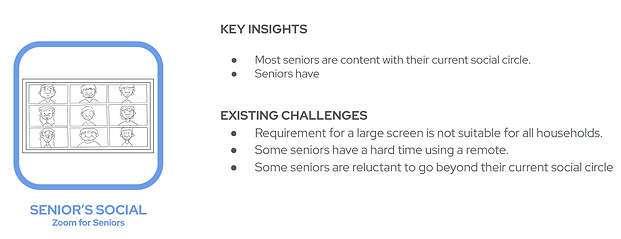
Senior’s Social
Zoom for Seniors
Promote social activities amongst seniors amid the pandemic.

USER LOOK INTERVIEWS
Presenting our concepts to users, we learned potential challenges in our designs from their feedbacks. By evolving our key insights, we then pushed our design further to one concept we considered most feasible, efficient and acceptable by both caregivers and loved ones.
1

2

3
Insights evolution

Seniors may need
physical modifications
to meet their ability level but want these products to signal their maturity level + have a braggability factor

Seniors want to
connect with others
outside of the home
regularly but feel
that their current
tech options are
good enough

Seniors are hesitant to adopt modifications
until they realize it will increase their independence and enjoy co-designing them

Seniors want a way to carry on their hobbies and expertise areas even when they can’t physically
Concept Selection

FURTHER DEVELOPMENT
To further develop the pillbot, we strive to transfer what we learned from the users to design features and corporate them to a more ergonomic, sleek looking in-home appliance.


REFLECTIONS
-
Value of thinking through a discussion guide vs. premade guide
-
Importance of having people show you as much as you can (even when virtual)
-
More intentional questions for home tour
-
Strategies in your pocket for politely pulling user back to topic
-
Start with more secondary research
-
Be more strategic about specific desired information from stimuli
-
Proof test concepts with peers before taking it to the user
-
Importance of debriefing right after the interview with fresh memory
-
Always look back at previous diaries, interviews, analysis with fresh eyes