top of page

Hats
The Sun-Smart Collection
Click here to edit the text and include the information you would like to feature.

Shoes
Comfort X Design
Click here to edit the text and include the information you would like to feature.

Bags
Transport In Style
Click here to edit the text and include the information you would like to feature.
Hats
The Sun-Smart Collection
Click here to edit the text and include the information you would like to feature.
Shoes
Comfort X Design
Click here to edit the text and include the information you would like to feature.
Bags
Transport In Style
Click here to edit the text and include the information you would like to feature.
- Experience Architect -

River Basin Management
Review Committee
[trans-boundary] Report
Project type: Design Research
Location: Mississippi, Maine, Rhine River
My role: Design Researcher, Team River Mekong Research Lead
Skills: Rhino, Google Earth, GIS, Adobe PS & Ai & Id
Research Mapping & Analysis, Book Design, Storytelling

Introduction
[About the Research]
The “trans” prefix provides a lens for which to analyze and understand watershed issues of the past, present and future. Whether political, geographical, economic, or social, we exist and operate in a global age of boundaries. Water traverses through all, challenging the very boundaries that we create to control it.
To embrace the prefix of trans means to understand water for what it is -- a fluid. By adopting a mindset of fluidity, watersheds can be understood holistically. Through a comparative analysis of three river basins that embody the word trans, we seek to shed light on the perils of boundary-making and suggest a more trans approach to understand the water that pulses through our rivers, our earth and our very bodies.

[Meet the Team]
Instructor: Derek Hoeferlin
Team Member: Caroline Amstutz, Michele Chen, Jake Deluca, Helen Han, Yin Li, Patrick Murray, Rodrigo Poma, Jimmy Ryoo, Will Sun, Rita Wang, Joie Zhang, Tiffany Zheng
Story
Background Story
Water is power. Water is political. Water is the common thread tying us all together, yet also the reason for our own fragmentation. Whether seen as a right or a luxury, our interactions with water shape our existence, our politics, our collective culture.
Our understanding of water reflects the political boundaries we’ve unsuccessfully imposed upon it; fragmented broken. This fragmented understanding of water and our human desire to impose upon its course is the crux of the following analysis. The Rhine, Mississippi, and Mekong river serve as portals to view hydro-fragmentation: its roots, effects and lasting impacts. These three river basins serve as a framework of analysis which can be applied to all other global river basins. Our analysis peers through the conceptual lens of the word “trans.” We aim for an understanding of the river basins that rejects contemporary politics and boundaries. One which embraces the very qualities of water that make it impossible to control.
In order to unpack the complicated relationship status with water, we must understand our past. Through analyzing the management, governance, and political history of each basin, a narrative about power can be extracted. Based on power, wealth, and the interests of a few, our approach to controlling water is in precise opposition of its virtues, its fluidity and freeness.
Water knows no boundaries; through recognizing the artificial boundaries that we impose on water, we realize the limits we have in controlling it. This transboundary, trans-basin analysis sheds light on the past, present, and future of our watersheds and their importance for the future of all life. Ultimately, we will suggest a new approach to understanding watersheds: an approach that reorients of point of view - adjusting our position to place water first. The new orientation sets each basin geographically from source to mouth. This shift prioritizes water, allowing us to speak a common language with water, to play by its rules. The adoption of this point of view resets our understanding of river basins: water is trans.

[Water: the sine qua non of life]
"trans"
– across, beyond, crossing, on the other side
transaction/transcend/transboundary/transcontinental/transdisciplinary/transect/transfer/transfiguration/transfix/transform/transgender/transvestite/transgress/transient/transit/transition/transitory/translation/transliterate/translocate/transmigrate/transmission/transmogrify/transmountain/transoms/transparency/translucency/transplant/transportation/transpiration/transonic/transversal
[What defines a River Basin?]
A river basin is the portion of land drained by a river and its tributaries, separated from adjacent basins by a drainage divide. - Wikipedia
This definition comes from a scientific perspective. Taken broadly, a river basin includes all the rivers and creeks flowing in it; the humans, flora and fauna living in it; the cities and towns drinking from it, as well as the natural and political boundaries defining and separating it. In this report, we will be looking at river basins in both ways, unpacking the tug-of-war between politics and geography; humans and nature.
[Why Rhine, Mississippi, Mekong?]
– past, present, future.
To examine how water has shaped the way people live, we have chosen to focus our study on three of the largest river basins in the world --- the Rhine, the Mississippi, and the Mekong. These three basins represent the past, present, and future of watershed architecture.

Rhine

Mississippi

Mekong
The Rhine has long-established success in water management dating back to antiquity. The river represents the past and sets an example for other river basins of the world. The political stability and historical and current structure of the nations allows for greater unity when devising legislature to protect the water and the people within the watershed.
The Mississippi, representing the present, is at a critical moment. The river has a rich history of infrastructure for the protection of people and the economy, but the systems are beginning to crumble. The issues of the Mississippi are current; without sufficient funds and resources to tackle contemporary issues, the Mississippi river will begin to degrade.
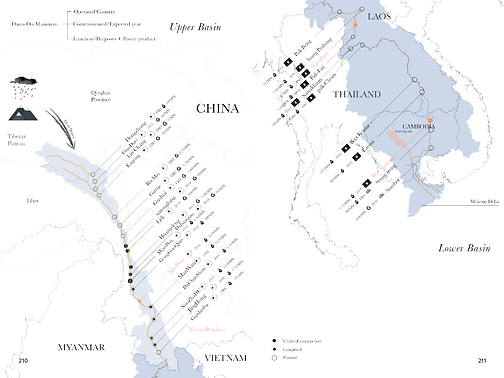
The Mekong, which flows through six nations in southeast Asia and impacts the livelihoods of many more, represents the future. The worsening effects of climate change and tension created by internal conflicts among nations pose a question about the sustainability of the river basin. Lacking in transnational unity to achieve successful water management, the Mekong represents a dream of achieving a harmonious co-existence between humans and nature by governing the watershed.
Research Content
Content
Sample pages I was in charge of writing & drawing...




bottom of page